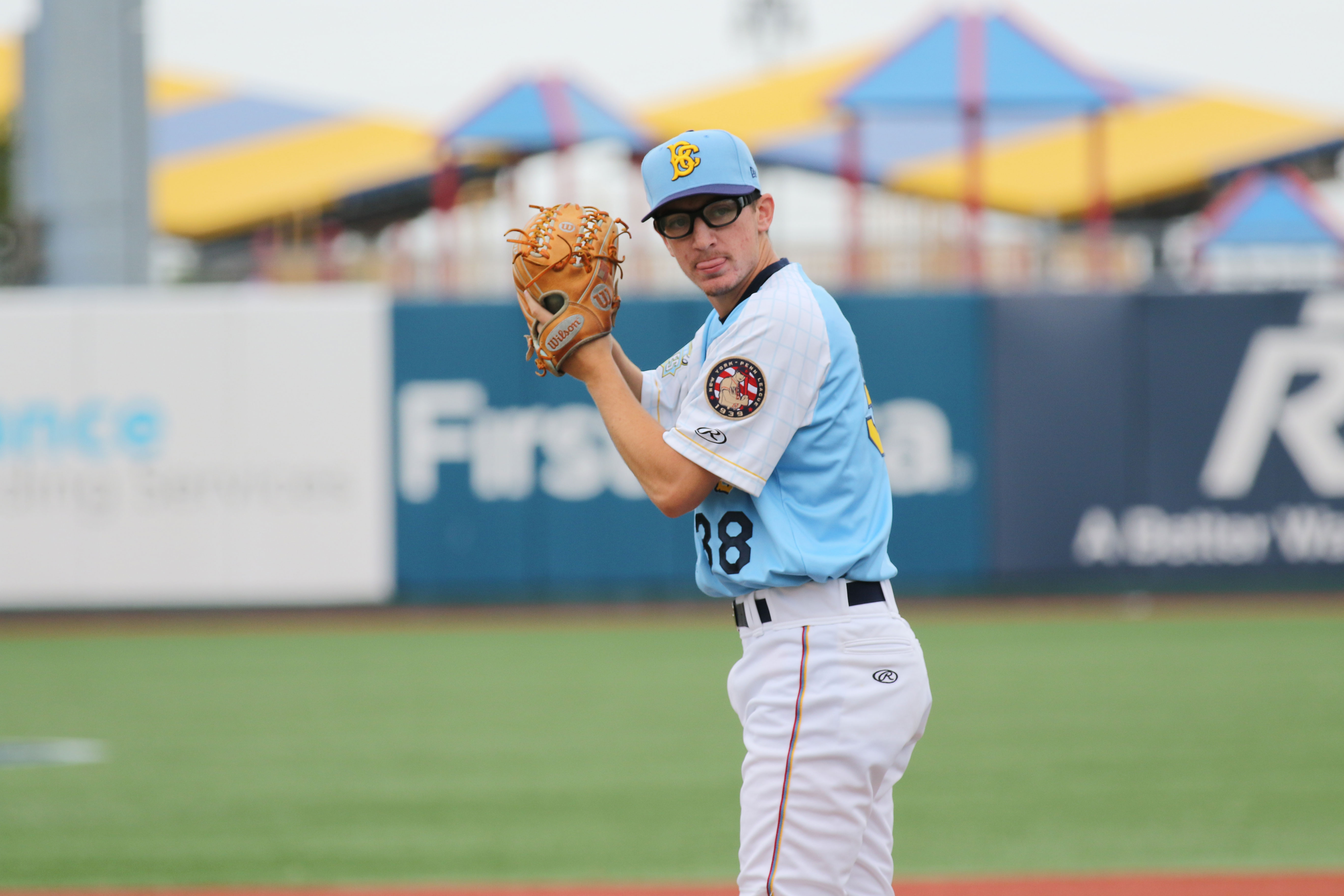
Josh Hejka (Liz Flynn/Brooklyn Cyclones)
Earlier this season, I had the privilege of talking with Mets Minor-League pitcher Josh Hejka. During his time in the Mets’ organization, the side-armer has blossomed into one of the most formidable backend arms in the entire farm system.
In 2024, Hejka posted a 3.77 ERA across 38 games between Single-A Brooklyn, Double-A Binghamton, and Triple-A Syracuse. With his outing on May 5th with Brooklyn, the former undrafted free agent set the record for the most appearances with the Cyclones, his 48th such appearance with the club.
Throughout his time with the Mets’ organization, Hejka’s fully embraced the analytical movement. He’s worked with several third-party organizations, such as Driveline, to fully optimize his unique delivery.
In conjunction with Hejka embracing the “Statcast” movement, the Mets have done similar, making immense investments in their analytical staff and equipment in recent years. Trackman, Edgertronic, and Hawkeye devices have been the norm throughout Minor League Baseball in the last half-decade.
Hejka was kind enough to recently chat with me about his Tommy John Surgery recovery, the current state of his arsenal, and the Mets’ recent investments in analytics.
MMN: 2024 is your first season back after Tommy John Surgery. How are you feeling?
Josh: I feel physically stronger; I feel mentally stronger. That experience of having the game taken away from me for a year allowed me to redial my priorities and understand just how much this game means to me. This year, I’m playing with a lot of gratitude.
One of the reminders on my phone is to play with joy, and just enjoy this experience and the ability to play professional baseball, especially at a high level like AA.
It’s just really cool, and it’s been great being back out here. I think I grew a lot mentally and physically as a person. Overall, the experience was worth it.
I’ve heard Spencer Strider say this, where he talked about his missed year with Tommy John. The reason he’s a big leaguer isn’t in despite that year he missed because of Tommy John Surgery; He’s a big leaguer because of that year, because of the strides he took during that rehab process.
It was due to how much he learned to understand his own body, his mechanics, and his workloads. And I think I feel very similarly about that year for me.
When I’m in the major leagues, I’m going to look back at that time and recall the reason I’m a major leaguer is because I had that year and how much I grew over that time.
Josh Hejka makes his first appearance since 2022 – 0.2 innings; no runs; 1 hit; 1 K; @BKCyclones @JustinRocke #Mets #LGM #MetsTwitter @ernestdove @MiLBMetsMadness @bkfan09 @WexlerRules @ImAriBeRKO @bronxfanatic @draftniks @TheBaseballHut pic.twitter.com/FJweLZARRi
— Mets News and Links (@JohnFromAlbany) April 8, 2024
MMN: Were there any changes you made to your arsenal during the time off from the surgery?
Josh: There’s a few differences that I took the time to make when I had a year to work on it.
You have that year with the rehab. Some people look at that as I have a break for this long. The way I tried to approach it was basically saying: I have a year to work on everything that I think is holding me back from being a big leaguer.
And some of that stuff is regarding the arsenal. There are a couple of big things.
Traditionally, lower-slot guys don’t throw as hard, but it’s still something that I can try to work out since it’s only going to help me out.
I made a few changes to my delivery, most notably, I’ve incorporated a leg kick now. Instead of being so quick to the plate, I have a full leg kick from the stretch and I have a wind up that I’ve been using.
In terms of the actual arsenal, I felt pretty good about it against righties. I have the sinker, the rising slider, and the cutter. The right-handed low-slot guys tend to do better against right-handed batters. Right-handed batters were never my concern.
Left-handed batters have always been something more difficult, whether it’s giving up harder contact or just the ability to not get a swing and miss as often. Those are things that I wanted to address.
I feel like I worked on some things over that year. And I’m attacking lefties in a slightly different way.
I think, this year, my splits against lefties have been much better.
I’m getting much weaker contact, more swings and misses and strikeouts. I’ve basically virtually eliminated using my sinker against lefties because it tends to just play right into their bat path.
Josh Hejka gets the win on Sunday for @BKCyclones after allowing the tying runs to score in the 8th, the offense scores 4 as they win 7-3 Hejka, 2 innings, 2 runs, 2 ER, 2 hits, 1 walk, 3 Ks. @JustinRocke #Mets #LGM #MetsTwitter @ernestdove @FarmToFlushing @bkfan09 @WexlerRules… pic.twitter.com/uJ3AsUkGy0
— Mets News and Links (@JohnFromAlbany) June 24, 2024
There’s times where I executed a really good pitch against lefties, like a low and away sinker, and they just stick their bat out and flick it to left field. It’s frustrating even if you make a good pitch and they’re just able to do that.
So I’ve replaced that with a four-seam that I’ve been using up in the zone. So the kind of triangle I use against lefties is at the top of the zone to the inside corner. And I basically stay away from the low and away part of the plate. I’ve had a lot of success this year working with that newly refined arsenal against lefties.
MMN: What’s the current state of your arsenal? What are your pitch’s metrics like?
Josh: I actually made a grip change earlier this year. In previous years, I had been around 84-85 mph with my sinker. Since my time in AA, it’s been a culture of 86-87 mph.
So I basically gained around two miles an hour since the last time I was playing a couple of years ago, which is exciting.
I made a grip change because I noticed that my sinker wasn’t getting as much negative vert as I wanted. There’s times when I throw one and it gets -7 or -8 inches [of vertical break]. But then there were times I noticed that I would be getting +3 or +4 inches of vert break.
So, in an effort to make my sinker’s vertical break more consistently negative, I made a grip change. I worked with one of our analysts, Will, to make a change.
He helped me find a grip based on maximizing seam shift wake and getting as much negative vert as possible. It’s basically a traditional two-seam grip, except I’m rotating and I’m crossing the seams instead of being parallel to the seams.
I’m slightly tilting the ball left in my hand because our high-speed cameras in our bullpen [Edgertronic and Trackman Machines] helped identify that the ball would tend to start shifting in my hand before I released it. And I would be pulling across it on an inefficient axis to get the seam-shifted wake.
But the slight grip adjustment allows me to pull along the optimal axis for seam-shifted wake. That’s where that two-seam has been much better for me.
I’ve been getting the two-seamer down to negative seven, negative eight, much more consistently. The four-seam is almost the exact opposite where the four-seam shifts positive.
I want to get as much positive vert on that pitch as possible so I can throw it at the top of the zone and miss a guy’s bat. I’ve been throwing that pitch with some positive seam shift wake.
And then my rising slider gets a lot of seam-shifted wake, mostly up. It’s spinning around closer to nine o’clock. And the seam-shifted wake is pushing that up to closer to a ten thirty. And that’s how I get so much vert on the pitch.
MMN: You mentioned a change you made with your sinker that one of the Cyclones’ Baseball Operations analysts helped implement. Where did the change originate from?
Josh: It was in collaboration with Will; one of his specialties is adjusting grips and looking at the different seam effects.
https://twitter.com/hedgertronic/status/1777454751128637651
I sat down with the pitching coach and the analyst in Brooklyn. We noticed, that sometimes the ball would seam shift up. And that’d be when I get those positive verts. And sometimes the ball would seam shift down, which is when I get those negative verts.
I think I threw three innings one day and I knew I was going to be down for a few days. We hopped on a bullpen mound, where we could use the Trackman to get movement feedback. And then we can use the Edgertronic to get feedback as to how I’m actually releasing the ball.
We basically said, let’s just play around with a bunch of different grips and see which one gets the most consistently negative vertical breaks. We started with my normal grip, played around with a couple of different adjustments, and eventually tried the one I’m at now.
Using the Edgertronic, we found the one that we thought worked, that had the most negative vert consistently.
That’s where I noticed that the ball was slipping on my hand sometimes. It was getting nudged a little bit by my index or my ring finger. And with the new grip, I would still be pulling on it from the correct axis to get that negative seam-shifted wake.
We noticed that these negative vert pitches are really good and the positive vert ones aren’t as effective. It was basically a collaboration through a lot of different departments, the pitching coach, and some of the analysts to fix this issue.
The first step was recognizing that that problem existed. Next was having the freedom to use the Edgertronic and the Trackman to go through a pitch design session and say, let’s get instant feedback as to what’s happening and how we can figure out which options are good and which options are bad. It was just a really smooth process throughout the whole thing.
Just identifying the problem, being able to get objective feedback, testing out new possible solutions, and then seeing that it actually works. It’s cool seeing the data-driven process because I think it’s just so effective and you can make adjustments quickly that have a large impact.
MMN: You’ve mentioned meeting with the Will and the Mets’ PD Department in Brooklyn. Is that something that’s been new over the last few years?
Josh: Things have definitely improved drastically since my first couple years here. I remember my first couple years here, we weren’t even allowed to see our data unless we were with a coach. We couldn’t see our velocities or our movement profiles. And it sounds crazy, but five years ago, our understanding of pitching was so radically different.
There was just a lack of understanding as an industry as to a lot of these topics. Nowadays, it’s great. There’s a lot of freedom of communication. The analyst and the pitching coach collaborate. You can go up to the analyst and ask questions.
He can come to you and say, I noticed this. The pitching coach can do the same thing. The environment that’s encouraged is very open and transparent. Creativity is encouraged and being able to try to solve these problems is great. So even guys who aren’t necessarily as invested in it as me or aren’t as proactive about looking at this stuff are still reaping the benefits
The environment that the front office is cultivating is so much more analytically driven and transparent in terms of producing results. It’s great. It’s been awesome to see that.
MMN: That creative environment you were talking about: Has that been a byproduct of, let’s say, Steve Cohen buying the team?
Josh: Yeah, from my understanding, he was able to invest a lot. But I think the Mets hired some really good people in the pitching department and the analytics department.
We’ve hired a lot of good people and those effects have trickled their way down just by having really good systems in place. I think that’s what’s been so exciting for me is just seeing how many great people we’ve hired.
I’m looking at Andy Green right now. He’s here. Everyone who’s in charge of making decisions and who’s in running these departments, they’re around. They have relationships with the players.
Daniel Schoenfeld, our head of minor league analytics, is around all the time. He talks to players. He’s extremely good at communicating. The fact that all these people are around and hear that players have a relationship with them, makes it easier for players to buy in when these extremely smart and talented people have opinions to offer.
Having a relationship with the players is the best way to get them to buy into something you’re saying.
MMN: Are there any other improvements that you’ve noticed?
Josh: There’s a lot of room in professional baseball, in general, for workload management.
It’s called Pulse and was brought by Driveline. I wear the Pulse sleeve every single throw I make, and it was extremely helpful during my rehab process. I wish more players were able to buy in on that, and I don’t know if it’s just a communication issue.
It seems obvious to me that the lowest hanging fruit (in a league where injuries are more common than ever and millions of dollars are on the line for players and clubs) is quite simple:
Every pitcher should wear PULSE or a similar sensor and track their throwing workloads. pic.twitter.com/Zg8iPeeVf2
— Josh Hejka (@hedgertronic) April 8, 2024
Pulse is basically a sensor you wear on your forearm. It tracks the amount of throws you make and how intense each of those throws are. You can have a deeper understanding of your workloads over over the course of a week, a month, or a season.
There’s a couple big things that I’ve gleaned from it.
One is understanding my recovery days. In my light days, I have to give my body the ability to recover. For example, if I pitched three innings yesterday, I have to give my body the ability to recover today.
When I first started using Pulse, I would tend to throw too hard on my recovery days. I think that’s a common thing across all of baseball: guys have the intensities almost too high on their recovery days to the point where they’re not actually recovering from the stress that they put on themselves in the game.
That was a big thing for me, is being more intentional about my intensities. Now that I’m in season, it’s extremely useful for me. In terms of, being a reliever, I obviously don’t know what days I’m going to pitch in game. So the only thing I can control as a reliever is my pregame throwing.
I use Pulse to help me manage my pregame throwing and get to a point where I’m confident that I’m still getting my work in, but I can also be confident that I can handle the stress of a game.
https://twitter.com/hedgertronic/status/1760432039906738399
For example, I’m not going to throw a 30-pitch bullpen on a day where I might need to pitch. But on the other hand, I’m also not going to just only play light catch for a week and then never pitch. There’s the balance of you have to have some high intensity and you have to have some low intensity.
MMN: You also spent time at Driveline. Can you talk about some of the changes that they’ve helped implement throughout the years?
Josh: That’s actually where I did the vast majority of my rehab process. I really liked the rehab process. The fundamental principles that they used were that the body is resilient and the body will adapt.
To develop a pitch that maximized IVB and still had sweep, I needed to throw a pitch similar to an over-the-top sweeping slider or slurve.
Using the grip database at Driveline, I eventually found a grip that felt comfortable and produced promising results. pic.twitter.com/H8jke6WOWX
— Josh Hejka (@hedgertronic) June 9, 2022
The way they kind of framed it as: you ask your body some questions and see how your body responds.
We don’t have to be afraid of stressing the body. Stress isn’t inherently a bad thing. It’s just a reality, right? It’s a demand of the sport that you’re playing. And the only way to prevent injury in the long run is to build yourself up so you can handle the stresses of the game safely.
Would you ever tell an Olympic deadlifter: don’t deadlift 500 pounds, it’s too much stress on your body?
No.
What you would tell them is: we know you need to deadlift 500 pounds in your event. So in your training, you need to prepare yourself to handle 500 pounds, if not more than that, so you can be safe in the event.
When you stress your body, it’s adapting to that stress that you give it, if you allow the time to properly recover. If you want to prepare your body for the stress of throwing, the stresses you should be experiencing in practice and training should be the same, if not higher.
Something I like to do is max long toss. I like to use weighted balls and underweight balls. When you use those tools intentionally, you’re actually putting more stress on the arm than it’ll experience in a game.
If you do it in a careful and intentional way, I have full confidence that my arm is going to be okay because I’ve known that I’ve experienced more stress in practice in a safe environment.
I have no doubts in my head that whatever I experience on the mound, I am physically prepared for.
Those are the principles that I use during my rehab process at Driveline. That’s why I think I feel so physically prepared for the season. My velocity’s been up and I’ve been feeling really, really good.
MMN: You just introduced a new metric called wRE24RA. Can you talk a little about that?
Josh: This isn’t a revolutionary stat that’s going to change pitching analysis. I have no doubt it’s definitely not as predictive as even something like FIP or SIERA, and definitely not better than, you know, stuff models and all that. But it measures something that isn’t currently publicly captured.
https://twitter.com/hedgertronic/status/1790428977871614333
My teammate with Brooklyn [Cyclones], Ben Simon and I were talking about this one day.
For example, a pitcher left the game with bases loaded, no outs. And then the next guy came in and got out of it without giving up a run. And we thought ERA didn’t display a reflective mark of what happened.
That the first guy gets zero earned runs and the second guy also gets zero earned runs. When in reality, that first guy, you know, left the bases, bases loaded, no outs.
And the second guy came in with bases loaded, no outs and got out of it. So that first guy should almost be penalized by how many runs he was expected to give up. So that’s kind of the theory behind it is that if you leave the bases loaded, no outs and there’s 2.5 expected runs to be scored, you get penalized by 2.5 earned runs,
If the next guy gets out of it, you basically get charged with 2.5 runs. The second guy should get -2.5 runs because he actually prevented 2.5 runs from scoring over what was expected.
That’s basically the general theory. Guys who tend to leave the bases with runners on base and put their team in a tough spot should still be penalized even if they have someone come in and save their butt on it.
It’s definitely not the most revolutionary stat, but I think it’s better than ERA in terms of describing how much you actually contributed to your team.
MMN: Have you done any correlation studies between SIERA, xFIP and FIP with expected RE24? is it sticky at all too?
Josh: I haven’t got that far into the weeds. Maybe this off-season. My guess is it wouldn’t be reliable because I think there’s probably a lot of luck that goes into it.
My guess is it’s probably more predictive than ERA, but less so than FIP or SIERA.
MMN: Last year was the first year the minor league CBA was in effect. Can you talk about some of the changes that have occurred as a result of that?
Josh: It’s really awesome to see how good, or how much better, things have gotten since the pre-CBA era. I’ve been reminiscing with some of my older teammates about how things were before.
This day in #MLBPA history: Minor League Players officially unionized. @MiLB_Players pic.twitter.com/0bHvvq9nLW
— MLBPA (@MLBPA) September 14, 2024
I don’t even know if reminiscing is the right word, I think my first paycheck was $400 for my first two weeks of professional baseball. And money was taken out of that for housing. It’s pretty frustrating that it took that long for MLB organizations to realize that even a small investment in their minor leaguers could pay dividends for their big league club in the future.
Basically MLB teams value one win above replacement [WAR] in free agency at about $9 million.
I think if we add up all the collective changes to the CBA, it’s probably a little bit less than that in terms of the additional contribution from the club. So it’s probably about $7 or $8 million, maybe about that $9 million mark in terms of higher wages and all the housing costs and the food costs.
Making it so that minor leaguers can focus on training in the offseason and don’t have to work a second job is a massive benefit. So they can be healthy during the season by being able to have a stable housing situation, by being able to eat good food.
Because it’s very apparent to me and anyone who understands minor league baseball that allowing housing security, food security, and higher wages now allows us not to necessarily work a second job in the offseason. We’re way more likely to develop into better players.
It was cool seeing the minor leaguers come together. and collectively bargain for more rights. I still think there’s a lot more work to be done, in terms of, recognizing how much value we actually provide to these organizations. But it’s come a long way and I think it’s important to remember that.
Last year was my first year of making money playing professional baseball. Every other year before that, I had lost money playing professional baseball.
I know multiple players who I know for a fact could have been big leaguers, but because of how little they were paid, they weren’t able to keep playing baseball because they had to provide for their families. It’s really frustrating to see guys like that lose opportunities.
I’m just glad things are changing for the better and we’re getting closer to a world where we recognize our true value. So, hopefully, we’ll just keep moving in the right direction.
MMN: In your opinion, what do you think is the next baseball technology to take hold? What’s the next thing we can quantify?
Josh: This already exists in some regards, but, higher-level biomechanics data. A lot of MLB stadiums have Kinatrax. They have cameras that have high-level biomechanics data from in-game situations. I think teams will start recognizing the value of biomechanics data.
We can help him make adjustments much quicker. We have objective data available that says: this is when your delivery was good, this is what your velo was. Your delivery’s this now and this is what your velo is, how do we get you back to that old spot?
And so, I think in-game biomechanics data is the next major revolution that’s going to happen.
Soundcloud Link: here.
This interview has been lightly edited for clarity.