
A few days before he was set to make his professional pitching debut, RJ Gordon found out the wind-chill temperature in Brooklyn was going to be around 20 degrees.
“Everyone was kind of giving me crap about it,” Gordon said. “Like, I’m gonna have to pitch on the coldest day before the weather turns, basically.”
But pitching through cold, gloomy weather is nothing new for Gordon. The six-foot right-hander was drafted last summer out of the University of Oregon, where he rose from being “probably the worst guy on the roster” to a 13th-round pick by New York.
Gordon is now a High-A Brooklyn Cyclone.
“The weather hasn’t helped a ton, but there’s still a good amount of fans coming out,” he said. “Fireworks on Friday nights, which is pretty cool. The vibes all around are pretty awesome.”
On Tuesday, Gordon got to show his stuff for the first time in a professional game. Stepping on the mound at Maimonides Park, right by the Coney Island shore, he turned in a solid outing of two runs in 4 2/3 innings against the Hudson Valley Renegades. All three of the hits he gave up came in the second inning. He ended his outing with a swinging strikeout of Antonio Gomez, giving him four punchouts on the evening. His fastball sat around 91-93 mph, per Cyclones announcer Justin Rocke.
“I had fun. Stuff felt pretty good,” Gordon said. “In the conditions, the velocity was down, which is all right. But was still kind of able to find a way to help the guys stay in the game a little bit.”
Gordon’s outing marked a significant landmark in a journey that started all the way in the opposite corner of the country. He grew up in Santa Clarita, just outside of Los Angeles. He’s a lifelong Dodgers fan.
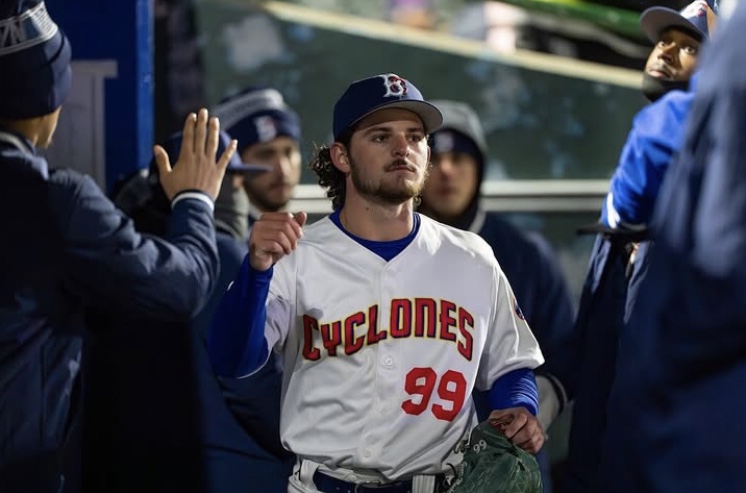
RJ Gordon with the Brooklyn Cyclones (via RJ Gordon/Brooklyn Cyclones social media).
Struggling to Get Innings as a High Schooler
Also hailing from Santa Clarita is Cincinnati Reds pitcher Hunter Greene. Gordon and Greene both attended Notre Dame High School in Sherman Oaks, with Gordon entering his freshman year while Greene was a senior. Gordon would often see Greene at Santa Clarita’s Line Drive Baseball Academy, he recalled.
“I just remember him throwing 102 when he was a senior, which was unheard of at that time,” Gordon said. “And now it seems like almost every day there’s a new high school arm throwing 100 miles an hour somewhere.”
Gordon played a few games in the field behind Greene, he recalled, before he went down with an injury. As Gordon worked his way back, he made what were essentially rehab outings with Notre Dame’s JV team. By the time Gordon was ready to go on varsity again, Greene was busy getting his professional career started with a second-overall selection by the Reds that summer. Gordon’s freshman year was essentially a wash.
But he stuck with Notre Dame for his first three years of high school, where he was mostly an outfielder. Gordon played alongside Lucas Gordon (no relation), a 2023 sixth-round pick by the Chicago White Sox, along with numerous other players who went on to D-I baseball. He also played against Harvard-Westlake’s Pete Crow-Armstrong, an eventual first-round pick by the Mets who they traded for Javier Báez.
“It was good vibes. They had really good baseball,” Gordon said. “And just really good teams, which definitely helped prepare me for the college and big league life a little bit.”
The most famous baseball alum from Notre Dame is New York Yankees slugger Giancarlo Stanton, who visited the team one time while Gordon was there.
Gordon recalled that the team had a cardboard cutout of Stanton in the locker room. Somebody joked that “Stanton’s in the locker room,” and everybody thought he was joking.
“And we go there, and [Stanton] was there to hang out at practice a little bit,” Gordon said. “And then he had a commercial filmed, and he was hitting balls on the freeway and over the football stadium in left.”
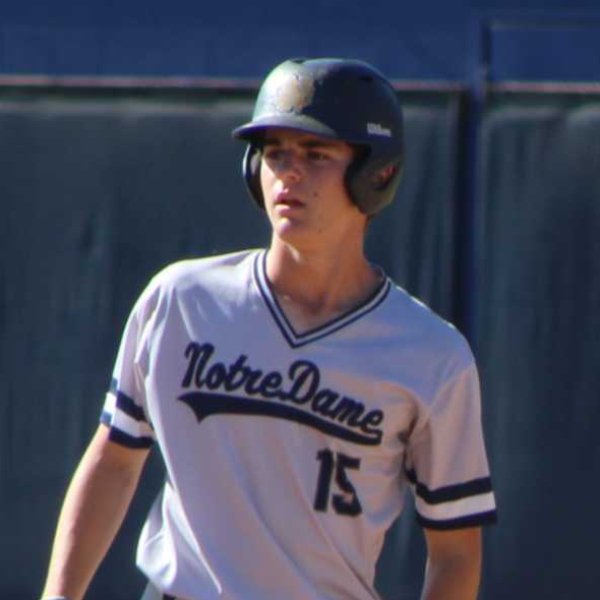
RJ Gordon playing for Notre Dame High School. (Photo via sportsrecruits.com.)
Gordon’s sophomore year at Notre Dame was his first full, healthy season on the varsity team. He batted .312 and was an All-Mission League honorable mention, but he made just two appearances on the mound. As a junior, he helped Notre Dame win a Mission League championship while batting .298 with an .845 OPS — but he didn’t pitch at all.
“I just wasn’t pitching,” Gordon said. “I knew that’s kind of where I had the best chance to have a future, was on the mound. Playing summer ball, I’d pitch, and the results were good. And I was feeling like, just with how things were going and how baseball is in general, that pitching was probably where I was gonna get the most looks — college and professionally.”
So, after three years at Notre Dame, Gordon transferred to West Ranch High School. It was a public school a much shorter drive from his home.
That summer, coming off a successful junior year, Gordon attended a camp called DudeDay in southern California. He both pitched and hit in front of scouts — a crowd that included Oregon hitting coach Jack Marder. They got to talking, then set up a recruit date. Gordon officially committed to Oregon in September 2019 after his second campus visit.
So, Gordon’s senior year of high school came with less pressure. He was already committed to a top D-I program, and he was playing at a school closer to home where he’d get more of a chance to pitch. He was a preseason All-American, and Perfect Game ranked him as the No. 17 outfielder in California. But the sudden COVID-19 pandemic cut his season short.
He still thrived in the time he got to play, batting .414 in 29 at-bats and making five relief appearances. He allowed just one unearned run in 9 1/3 innings with 12 strikeouts.
RJ Gordon’s MaxPreps profile photo for West Ranch High School.
Despite craving a larger sample of innings, he set off towards Eugene, Oregon, to play high-level D-I baseball in a rainy Pacific Northwest environment.
Establishing Himself at Oregon
In his first fall with the Ducks, Gordon said every coach and player would have likely attested that Gordon was the worst player on the roster.
Did he ever imagine he’d be drafted?
“Personally, yes,” Gordon said. “Everyone else would say absolutely not. But me, always from a young age, I always kind of knew, just the way I was brought up with my family and everything: We have the goal that this is gonna happen. It’s kind of already happened in our mind.”
(Gordon’s dad, Jason, played professional golf on the PGA Tour.)
With the COVID-19 chaos still ongoing in late 2020, schools’ fall rosters had no limits. So, fortunately for Gordon, Oregon didn’t need to make any immediate cuts upon his arrival.
But then the fall ended. The Ducks’ coaching staff “basically told me, ‘Hey, you’re not gonna play at all for us, ever,'” Gordon said.
He was presented with the option to either leave or redshirt. He chose to stay.
“I committed there to go there, and so I wasn’t gonna just bone out and take the easy route in my mind,” Gordon said. “Because, to me, if I couldn’t play at Oregon, then there’s no way I’m gonna get drafted and play professionally.”
He stayed on and went to work. He continued honing his craft and put on some weight in the process. Oregon head coach Mark Wasikowski told him he was officially a P.O. (pitcher only), although he still played outfield and did some baserunning during practice, as a “just in case.”
Gordon made Oregon’s Opening Day roster in 2021, albeit with an uncertain role and a still-realistic possibility of redshirting. The Ducks opened their season at home against Seattle on Feb. 25 that year, with COVID-19 precautions still limiting fan and media attendance. Gordon sat in the bullpen for most of the game.
Then, around the eighth or ninth inning, as he recalled, someone ran out to the bullpen to tell Gordon that Wasikowski wanted him in the dugout.
“I was really confused why he’d want me in the dugout,” Gordon said. “And they gave me a helmet and batting gloves and said, ‘Hey, if Gabe Matthews walks right here, one of you three’ — there was me and two other guys ready to go — ‘we’re gonna pinch-run for this guy.'”
Oregon trailed 3-0 going into the bottom of the ninth in that game. Matthews (who later played for the Angels organization) was hit by a pitch to keep the line moving. After an error and a single, Gordon pinch-ran for Sam Olsson to officially make his collegiate debut.
He eventually scored the walk-off, winning run on a sacrifice fly. His career started with a flash, diving into home plate and pumping his fists.
“A pretty cool memory,” Gordon said.
He made his pitching debut at the college level just a little over a week later. He threw two hitless innings against UC Santa Barbara, with five strikeouts and only one walk. He recalled topping out at 95, though he was averaging around 88-92 mph on his fastball back then.
Gordon’s first eight collegiate appearances were all scoreless, working solely out of the bullpen. He had accumulated 11 1/3 scoreless innings by that point. The streak ended with two runs in two innings against USC on April 16. A four-run outing later that year ended up ballooning his ERA to 4.19 by the end of the season. He struck out 20 in 19 1/3 innings overall.
Despite faltering late, he still made a solid first impression as a reliever.
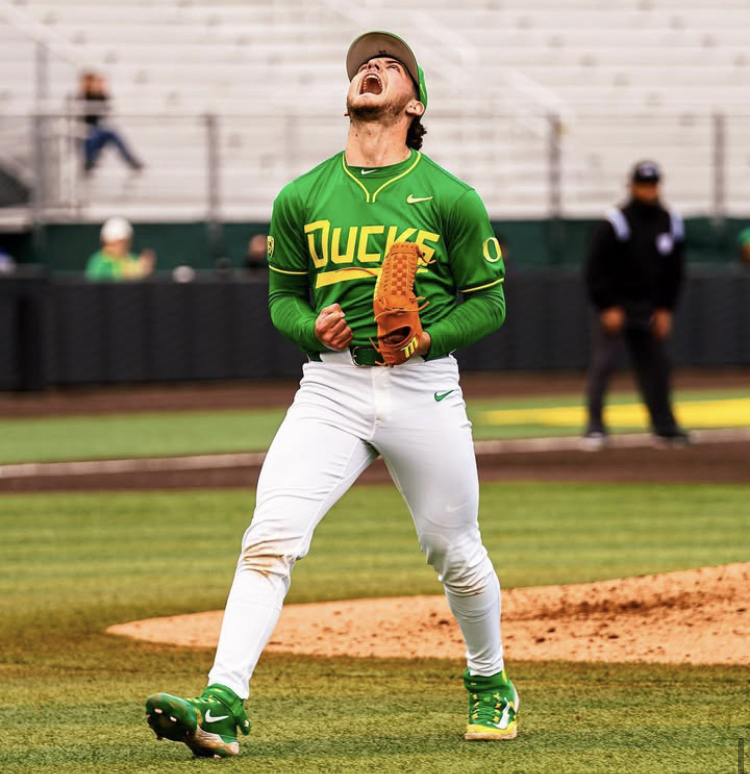
RJ Gordon at Oregon. (Photo via Oregon baseball.)
His sophomore year saw some marginal improvements, and the chance to start for the first time at the college level. He made 20 appearances, eight of which were starts. Many of his non-starts were long relief appearances. Some highlights that year included 4 2/3 scoreless innings against Stanford, one earned run in 5 2/3 against Cal and one earned run in 6 1/3 against Arizona State.
Overall that season, he had a 5.64 ERA in 68 2/3 innings. His strikeout-to-walk ratio was an underwhelming 48-34.
And then he got hurt. Gordon required internal brace surgery for a UCL injury, and he missed the entire 2023 season. It stalled his progression, at least at the time.
“The injury my junior year — really, to me, it was like, how can I get healthy?” Gordon said. “How can I get back on the mound?”
But when he came back as a senior last season, he earned a role starting on Friday nights for Oregon. And it was, by and large, a success. Gordon allowed three earned runs or fewer in eight of his first nine starts of the year — which is an even more impressive feat in college baseball than it is in the majors, given the high-scoring run environment.
After throwing 8 1/3 innings of one-run ball against USC on April 12, Gordon’s ERA was 3.60.
His growth coincided with the hiring of Oregon pitching coach Blake Hawksworth, a former big leaguer with both the Cardinals and Dodgers. Gordon said he still talks to Hawksworth every week and probably will for the rest of his life.
“Hawk’s the man. Probably, to this day, the best coach — just all around — I’ve ever had,” Gordon said. “More than just a coach, but just like how to be a man. A lot of mental hurdles he helps you overcome… I learned a lot from that guy. I truly do believe if he didn’t come into Oregon, and I wasn’t there at that time, that my life could be a whole lot different right now.”
Gordon, who wasn’t a huge strikeout pitcher in 2022, struck out 10 in 5 1/3 innings in a game against UCLA in 2024. He threw at least five innings in all but two outings during the regular season, and at least 4 1/3 innings in all of them. He held San Diego to three runs in seven innings in the Santa Barbara Regional, lowering his ERA to 4.69.
His season ERA ended at 5.13, but only after surrendering six earned runs to a loaded Texas A&M offense in the Super Regional. He struck out 87 batters in 94 2/3 innings overall. Batters hit .256 against him.
It was a 17-start sample good enough to put his name in draft conversations. He also topped out at 97 mph — a far climb from the freshman kid who wasn’t even always cracking 90.
Hearing His Name on Draft Day
Gordon had about a month after the college baseball season ended before it was time for the MLB draft. He knew he was getting drafted, he said, but he had no idea what round or team he’d end up with.
“I actually — which is kind of funny — I didn’t talk to the Mets once before the draft,” Gordon said. “I didn’t have one single conversation, text, phone call or anything with anybody, which was interesting.”
Gordon said that on Day 2 of the draft, which was when rounds 3-10 were held, he had a couple of calls but nothing materialized. Then, on Day 3, he had a busy morning in anticipation of rounds 11-20.
Gordon was watching the draft on TV, which had about a 30-second delay from the online draft tracker. So, about 30 seconds before his name was called on TV, his phone started blowing up with texts of congratulations.
“I knew I got drafted when my phone started buzzing like crazy in my pocket,” Gordon said. “My family was all sitting there, waiting. Had no clue what was going on. So it was kind of cool.”
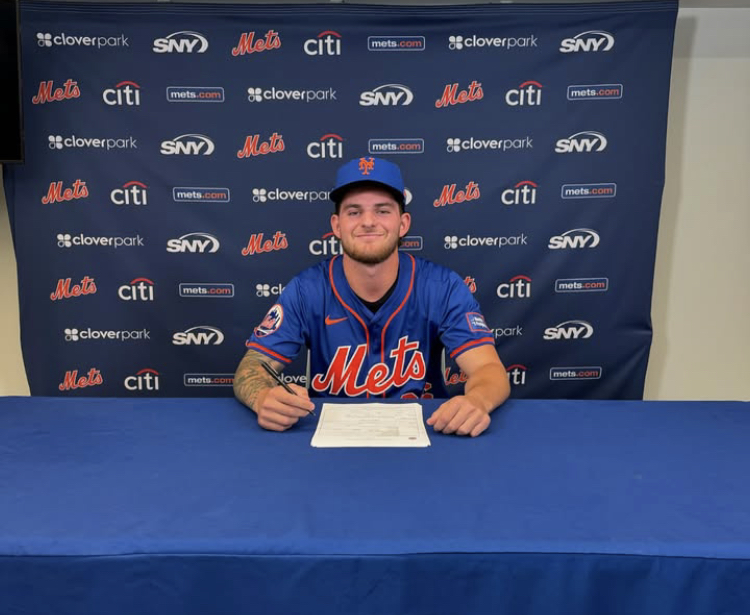
RJ Gordon signing with the Mets (via RJ Gordon social media).
The L.A. native realized he was heading to the East Coast. Meanwhile, that same day, his hometown Dodgers drafted his best friend and Oregon teammate, Fresno-born Isaac Ayon, in the 18th round. Ayon was a freshman at the same time as Gordon, and the two of them lived together in college. But Ayon ended up missing all of 2023 and ’24 with injuries.
“We’re close. We talk every single day,” Gordon said. “It’s cool to see, especially after all the hardship he’s been through the last few years with injury and not being able to kind of get over that hump — which, it seems like he’s over that hump now, which is great. For him to get drafted by his hometown team is pretty cool, so he’s living out that dream, which is pretty awesome.”
Gordon now gets to root on his friend in the Dodgers organization, while shifting his own focus to the Mets. His Dodgers fandom has taken a back seat, but he said he’s built a greater appreciation for the collective game of baseball.
“Ever since I was in the later years of college, you kind of lose, like, ‘I want just this team to win it all,’ and more of, like, you just love the game of baseball,” Gordon said, “and enjoying everyone’s success and failures together.”
He admitted it was weird watching the Dodgers and Mets play each other in the NLCS last year.
“I had no clue who to root for because I’d been part of the Mets organization for weeks, whereas I’ve been a Dodger fan my entire life,” Gordon said. “Of course I’m a Mets fan now because they put their interest in me and drafted me, but I just enjoy the game of baseball as a whole.”
Developing His Arsenal With the Mets
The day after the draft, Gordon got flown out to Port St. Lucie for draft camp. He dove right into the fire, working out with his fellow new Mets prospects and developing his skills.
One of the first pitches he started tinkering with upon arrival was a kick change, a recently popularized offering that has helped Clay Holmes, as just one example, find success. He said he didn’t have a great changeup after surgery, and that he’s had to readjust his pitch types and mechanics since coming back last year.
“The kick change just feeds more into how my body works now,” Gordon said. “And it came pretty naturally. It came pretty quickly. And now it’s developed to what I’d say could be easily my best pitch at this point.”
He’s also chasing his goal of hitting 100 mph, which he said is likely the pursuit of most young pitchers these days. But, more importantly, he wants to raise his average fastball velocity from where it was his senior year at roughly 92.5. He said he sat around 94-96 during spring training.
“Velocity kind of also comes with age and growth,” Gordon said.
Ultimately, Gordon wants to be a guy with a wide array of offerings. He compared his desired arsenal to that of pitchers like Seth Lugo, Aaron Nola, Mitch Keller and Michael Lorenzen. He emphasized that he’s already added more pitches to the mix.
“So there’s really no tendencies from a hitter’s standpoint. They don’t know what I’m gonna throw, really, at any point,” Gordon said. “Which is kind of what I’m building and what I’ve built. And so just keep working on that against hitters, and keep developing that and growing as a pitcher.”
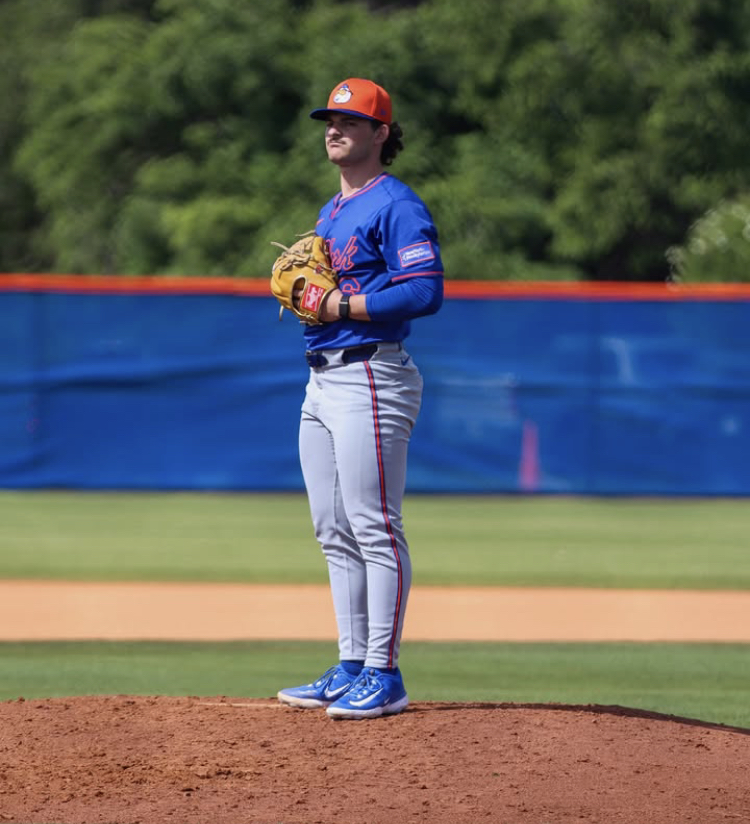
RJ Gordon pitching during spring training (via RJ Gordon social media).
Gordon debuted on April 8, the day before his teammate and new roommate, Mets second-round pick Jonathan Santucci. The players and coaches are all living in some of Brooklyn’s nicest apartments, with easy access to the field, beach, etc. Gordon said that Minor League Baseball’s rules have changed over the last couple of years in terms of the accommodations teams are required to grant their players.
“I’m in a very nice organization that likes to spend money,” he said. “The grind that you hear of, of the horror stories of 30-hour bus rides and all that stuff — it seems like it’s kind of in the past of minor league guys just in general.”
Gordon is facing his new minor league life head-on. He’s armed with determination and adaptability, allowing him to compete at a talent level that most people thought he’d never get to in the first place.
“I can’t really control getting sent up, sent down,” Gordon said. “That’s the business side of things. And that’s a whole different world. But for me, I’m just kind of enjoying 135 games — it’s a lot different than the 60-ish we get in college. So just enjoying every day and getting prepared for each start.”
