
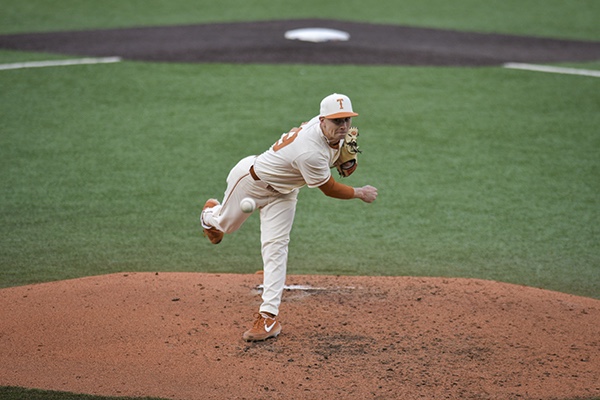
Anthony Mireles/The Daily Texan
Kolby Kubichek, RHP
B/T: R/R Ht: 6’0 Wt: 180 LBS
Age: November 28, 1999 (22 years old)
Acquired: Mets 2021 18th round draft pick (Texas)
2021 Stats (FCL/St. Lucie): 0-3, 7.71 ERA, 7 G, 3 GS, 18.2 IP, 1.82 WHIP, 11 BB, 12 K
Sometimes you can look at a player’s stats in college or even his first taste of professional baseball and see something to get excited about. That’s not the case here.
Other times, the excitement lies in huge arm strength or outlier spin rates. Or sometimes, there is big frame-based projection.
Well, Kolby Kubichek can boast none of those things. And yet, there’s a case to make as to why there could be more here than meets the eye.
Kubichek, a modest-framed red-shirt sophomore, signed with the Mets instead of returning to a successful Texas Longhorns team that made it to the College World Series after he helped that effort significantly. He threw 51.0 innings as a starting pitcher posting a 3.86 ERA.
Kubichek struggled with his command, and his path to the big leagues will require a big jump in that area, as his raw stuff is more movement-reliant than power, especially by today’s standards.
Kolby Kubichek pitched a career-high 6 innings with another career-high 9 Ks.@TexasBaseball took the series over Houston with an 8-2 win today. pic.twitter.com/18PIAK4hsF
— Longhorn Network (@LonghornNetwork) March 7, 2021
Keep in mind. Kubichek has not always shown control issues. In 2019, against premium Cape Cod League competition, summer in the, he walked only nine batters while striking out 34 in 30.0 innings. With his 0.90 ERA, he put his name on scouts radars pitching to a 0.90 ERA that summer.
While things did not go quite as well in his draft spring, Kubichek has always showed tremendous grit and competitiveness on the mound. More than that, as noted above, he’s shown terrific movement on his pitches.
Pitching from a high 3/4, nearly over the top arm slot, Kubichek gets quality sink and tailing action he gets on his fastball. Kubichek can touch 93 mph and avoid barrels.
Kubichek has a fluid and repeatable enough delivery and a relative lack of reps as a red-shirt sophomore to have a chance on a command jump with professional instruction. You can perhaps say the same for his already strong changeup.
When he’s locating well, he produces ground balls. While everybody loves the idea of gas at the letters blowing hitters away, there are a multitude of modest-sized right-handers that have had great success in the big leagues with this kind of fastball: Marcus Stroman, Kyle Hendricks, and Zach Davies to name a few of the best. Note, all of them command their pitches extremely well.
While everybody also loves to see a huge-spin breaking pitch, some of those names also do not boast one. Though Kubichek will work in both a curveball and slider, they project as fringe pitches. However, with Hendricks and Davies serving as big league comparisons, a right-hander can lean heavily on a changeup in its place.
Kubichek does in fact show good feel for his changeup, and it will show solid arm-side fade in the low to mid 80s. If the Mets can help him get even more action on the pitch, pushing it into true plus territory, that could be a path forward here for the young right-hander.
All things considered, Kubichek’s ability to realize the dream of making the big leagues could be narrow. That said, Kubichek is a prospect who could benefit greatly from the new analytical advances in the Mets minor league system.
The mission for both is to harness Kubichek’s spin and movement. If they’re able to do so, he’s exactly the type of late round pick who could surprise.
