
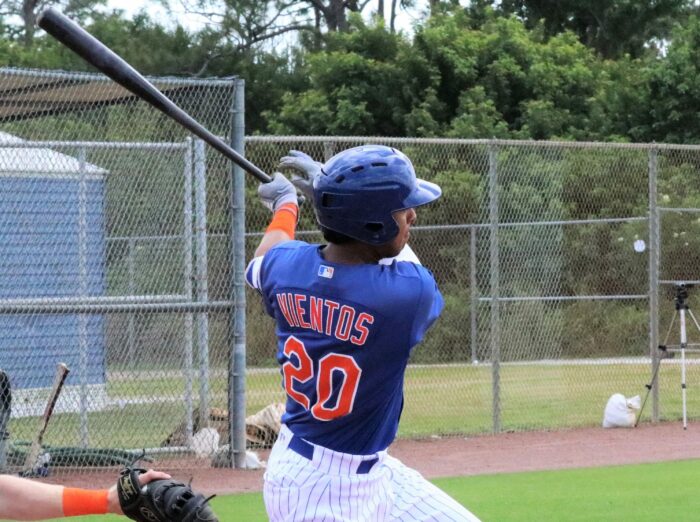
Photo by Ed Delany, MMN
No. 5 Mark Vientos, 3B
B/T: R/R Age: December 11, 1999 (22)
Ht: 6’4″ Wt: 200 lb.
ETA: 2022 Previous Rank: 6
Acquired: Drafted in the 2nd round of the 2017 June Amateur Draft
2021 Stats (Binghamton/Syracuse): .281/.352/.581, 18 2B, 25 HR, 63 RBI, CS
Mark Vientos entered the 2021 season as a top prospect in the Mets organization, but the once glowing luster seemed to be dulling a bit. Four years after being drafted, he had met every test that he had encountered, but we had yet to see his enormous raw power translate into him becoming a top hitting prospect in the minor leagues.
Part of this was an unfair judgment based on “prospect fatigue” that was further exacerbated by a lost 2020 season, but it did feel as though this was the year when Vientos needed a breakout. And break out he certainly did, with an impressive power surge that has landed him on several national Top 100 prospect lists. However, while several concerns were put to rest, others continue to persist.
Vientos was drafted towards the end of the second round of the 2017 draft. He was, however, regarded by many to be a borderline first-round talent who only dropped as far he did due to an injury in his senior year of high school and concerns about signability. The Mets lured him away from the University of Miami with a $1.5 million signing bonus (about $400,000 over the slot value), and he was assigned the Gulf Coast League that summer. Just 17 years old for the entire summer and primarily playing shortstop, Vientos held his own as one of the youngest players in the league.
The following year, he was assigned to Rookie-League Kingsport for his second professional season. No longer considered a shortstop, he played every game at third base. But what he lost in positional value, he certainly made up for with an outstanding offensive season. Still 2.3 years younger than the average player in the league, he finished the season with a .287/.389/.489 slash line and 11 home runs, good for a 132 wRC+. The power was exceptional for an 18-year-old, of course, but what was perhaps most remarkable were the improvements Vientos made with his plate discipline. His walk rate nearly doubled from his debut season to 14.1%, while his strikeout rate sunk to an excellent 16.4%. It was with this season that Vientos began to make his first few Top 100 lists and the sky seemed to be the limit for him offensively.
The 2019 season represented a bit of a step back for Vientos in every facet of his game. With his strong 2018 season, the Mets decided to have him skip over Brooklyn and jump right into full-season baseball at Low-A Columbia. When considering his year, it is important to note that this was an aggressive assignment and, in fact, Vientos only had seven plate appearances against a pitcher who was younger than him.
Still, a .255/.300/.411 slash line with 12 home runs, while slightly above the league average, was not the follow-up many had hoped to see. Most concerning was less the lackluster .156 ISO in a pitcher-friendly league than the cratering of his walk rate to just 4.8% accompanied by a jump in strikeout rate to 24.2%. It wasn’t a bad year by any means, but plate discipline issues such as these can be deadly for a young prospect if not addressed or if that prospect does not have another tool that can carry him.
With the cancelled 2020 season, Vientos spent his time training at the alternate site in Brooklyn, but he had to wait until May 2021 to prove the naysayers wrong. When the minor league season finally arrived, Vientos was given another aggressive assignment, skipping over High-A to start the season as Double-A Binghamton’s everyday third baseman. He struggled for his first 10 games – hitting .132/.209/.290 but took off shortly thereafter and never looked back, as he hit .302/.373/.621 for the remainder of the season.
A late-season promotion to Syracuse was delayed for a couple of weeks due to a bout with COVID-19, but Vientos did not miss a beat at the next level as soon as he returned. Vientos’ season was not only far and away the best of his career, but was one of the best offensive seasons in the entire minors last year: among all minor leaguers with at least 300 plate appearances, he ranked 13th in HR/FB% (29.4%), 15th in ISO (.300), 19th in slugging (.581), and 40th in OPS (.933).
Mark Vientos home run.
This is a scheduled tweet. pic.twitter.com/WvUyo73E59
— Syracuse Mets (@SyracuseMets) September 29, 2021
However, despite this season being an unequivocal success for Vientos, there are still concerns that are apparent in his stat line. The first concern is something which has been an issue since Vientos was drafted, but which became more complicated in 2021: his defense and his ultimate position. During the season, Vientos played a position other than third base for the first time since 2017. Vientos played third base in just over 60% of his games last year; the rest were split evenly between first base, left field, and designated hitter. Much of the cause for this branching out into different positions was because of the promotion of top third base prospect Brett Baty to Binghamton, but, given Vientos’ known defensive struggles, one wonders whether he will soon call one of these other positions home.
The second major concern was that Vientos’ strikeout rate climbed even higher last season to a career high of 28.7%. His walk rate did climb in tandem to 9.5%, a far cry from his career high in 2018, but still a significant improvement. However, Vientos’ rising strikeout rate cannot be solely attributed to increased patience, as his swinging strike rate climbed to a career-high 16.6% last year, a total which was 23rd highest among all Double-A hitters and would be just a touch below that of high-strikeout major leaguers like Adolis Garcia and Fernando Tatis Jr. The latter example shows that it is still possible to be an excellent hitter in the majors with a high swinging strike rate, but it is something to keep an eye on as Vientos progresses.
https://twitter.com/genymets/status/1488608895643922435
The scouting report for Vientos highlights both the strengths and weaknesses that are apparent in his stat line. The first aspect of Vientos’ game that needs to be mentioned is, of course, his power. Even before his breakout in 2021, raw power was always Vientos’ carrying tool. Fangraphs already rates this tool as plus and, because he still has room to fill out, they project that it will become plus-plus.
His impressive power finally began to manifest itself in games during the 2021 season, as can be seen not only in his home run totals, but also in his average exit velocity. According to Michael Mayer of MMN, Vientos had an average exit velocity of 92.3 MPH in Double-A this season, a number which would have tied him with Kyle Schwarber for 24th in the majors last season out of 328 hitters with at least 150 batted-ball events. This power is driven by the outstanding bat speed that Vientos can generate as well as his near-ideal use of his lower body (short and balanced leg kick, great torque at the hips, etc.), as can be seen in the video above.
However, while his power will carry him to the majors in the near future, Vientos’ hit tool and plate discipline still have some issues. First, despite having an incredibly quick bat, he has a tendency to wrap it around his head before swinging and there is a small hand hitch right before he pulls the trigger to swing, making his swing a bit on the long side. Because of this, he may struggle with elite velocity, but it also may explain his tendency to hit the ball with authority to the opposite field, something which he did very successfully in 2021 and which is well illustrated in the following spray chart by Jacob Resnick:
Who were the best raw power hitters in the #Mets system this year? Estimated fly ball distance leaderboard:
Khalil Lee – 330 ft
Mark Vientos – 324 ft
Carlos Rincón – 318 ft
Francisco Álvarez – 317 ft
Luke Ritter – 314 ftHome run spray charts (stringer input data) ⬇️ pic.twitter.com/k8UVwkaBGS
— Jacob Resnick (@Jacob_Resnick) October 8, 2021
Additionally, his swing features a clear uppercut, which is great for generating lift, but, as Prospect Live’s scouting report notes on him, leads him to struggle “with elite spin and elevated fastballs.” Vientos’ plate discipline also leaves something to be desired. Fangraphs lists him as being below average both in pitch recognition and bat control, while also noting that “his tendency to expand when behind in the count further exacerbates his swing-and-miss problems.” Fortunately, while these issues have prevented Vientos from tapping into his raw power in the past, they had improved sufficiently to allow him to put up a monstrous season power-wise in 2021.
Defensively, most prospect evaluators seem hesitant to label Vientos as unathletic, but he certainly lacks the quick first step that is so important for those who man the hot corner. And, despite his lean frame, he is quite slow in general, with his speed grading anywhere from below average to well below average. Therefore, his range is limited, as evidenced by his range factor per 9 innings at third base being just 1.98 in 2021 (for comparison, Baty’s was 2.64).
He has also struggled to make the routine plays consistently, as he made 10 errors in 98 chances last year. It seems likely that, as he fills out even more, his poor defense will require a move to a different position. Vientos has a plus arm, so speed would be the only thing that could potentially hold him back from being successful in a possible shift to the outfield.
Heading into the 2022 season, Vientos remains the type of player who will heavily rely on one tool – power – to bring him success at the highest levels. In this sense, his profile hasn’t changed significantly since he was drafted. However, the fact that he has finally shown just how much of a game-changer his power can be is extremely encouraging when projecting a future role in the majors.
And one such role may have been created for him with the new Collective Bargaining Agreement, as the Mets now find themselves in need of an everyday designated hitter. If Vientos picks up where he left off in Syracuse this April, there is a very strong chance that we see him filling that role as early as midseason 2022. At that point, the only question will be whether his hit tool holds him back – forcing him to improve the gaps in his game on the fly – or whether his power is so unstoppable that he makes an immediate impact at the highest level.
Mets Top Prospects 29-30
Mets Top Prospects 27-28
Mets Top Prospects 25-26
Mets Top Prospects 23-24
Mets Top Prospects 21-22
Mets Top Prospects 20 Eric Orze
Mets Top Prospects 19 Hayden Senger
Mets Top Prospects 18 Jaylen Palmer
Mets Top Prospects 17 Adam Oller
Mets Top Prospects 16 Jake Mangum
Mets Top Prospects 15 Carlos Cortes
Mets Top Prospects 14 Joel Diaz
Mets Top Prospects 13 Calvin Ziegler
Mets Top Prospects 12 Simon Juan
Mets Top Prospects 11 Jose Butto
Mets Top Prospects 10 Nick Plummer
Mets Top Prospects 9 Dominic Hamel
Mets Top Prospects 8 Khalil Lee
Mets Top Prospects 7 Alex Ramirez
Mets Top Prospects 6 J.T. Ginn
